Opinion
Beyond Nationalism: Rethinking Identity in an Ecological Age
The most meaningful map of the world may no longer be the political one we have inherited.

Charuhas Dali | Geopolitical tensions have once again defined the early decades of the twenty-first century. From the wars in Eastern Europe and Western Asia to escalating rivalries among major powers, the world remains deeply organized around the logic of the nation-state. Governments defend national interests, borders define political responsibility, and citizens mobilize around flags and national identities.
Yet beneath this familiar structure, the global political landscape is showing signs of strain.
The global political landscape is showing signs of strain.
According to the Economist Intelligence Unit’s Democracy Index, the global average democracy score has fallen to 5.17 out of 10, the lowest level since the index was first published in 2006. Only 25 countries are currently classified as “full democracies,” representing roughly 6–7 percent of the world’s population, while large portions of humanity live under hybrid or authoritarian regimes. The system of nation-states that once promised democratic self-governance appears increasingly uneven in its outcomes.
At the same time, the meaning of citizenship itself is becoming more fluid. International migration continues to grow, with the United Nations estimating more than 300 million people living outside their country of birth. Many countries now permit dual citizenship, and the number of people seeking naturalization or second passports has increased significantly in recent years. Germany, for example, granted citizenship to a record number of applicants in 2024, while the United States has naturalized millions of new citizens over the past few years.
Taken together, these trends reveal an interesting paradox. The world remains politically organized around national identities, yet millions of people are simultaneously seeking additional or alternative citizenships. National belonging continues to dominate political discourse, even as the realities of migration, global interdependence, and environmental challenges make those identities increasingly flexible.
Meanwhile, many of the most pressing problems of our time-climate change, water scarcity, biodiversity loss, and ecosystem degradation-do not follow national borders at all. Rivers cross countries, forests span continents, and atmospheric systems ignore sovereignty.
This raises a deeper question for the twenty-first century: if the challenges shaping humanity are ecological rather than national, should our sense of belonging remain defined primarily by the nation-state?
The Historical Rise of Nationalism
Despite how natural it may seem today, national identity is a relatively recent development in human history. For most of the past several millennia, people did not primarily identify themselves through the lens of nation-states.
Before the rise of modern nationalism in the eighteenth and nineteenth centuries, political identity was shaped by a variety of affiliations: cities, kingdoms, empires, dynasties, religions, and cultural regions. A merchant in medieval Europe might have described himself as a citizen of a particular city, a subject of a monarch, or a member of a religious community rather than as a member of a nation in the modern sense.
The emergence of nationalism was closely tied to the transformation of political order in the modern era.
The emergence of nationalism was closely tied to the transformation of political order in the modern era. The decline of dynastic empires, the spread of print culture, the rise of centralized states, and the political upheavals of the late eighteenth century-most notably the French Revolution-helped create the idea that political legitimacy should be grounded in a unified “people” sharing a common national identity.
Nationalism has been one of the most powerful political forces of the modern era. It helped mobilize movements for self-determination, dismantle empires, and give political voice to communities seeking autonomy. Yet the same force has also produced some of the darkest chapters of modern history.
In its most extreme form, nationalism can become exclusionary and destructive. Nazi Germany remains the most notorious example, where an obsessive vision of a racially defined nation became the ideological foundation of the state. National identity was weaponized to justify territorial expansion, persecution, and genocide.
The lesson is not that nationalism is inherently evil. Rather, it reveals how deeply powerful the idea of the nation can be, capable of inspiring both solidarity and conflict. When identity becomes tightly bound to territory, sovereignty, and a singular definition of “the people,” the political stakes rise dramatically.

The nation-state became the dominant model of political organization in the twentieth century, reinforced by institutions of governance, education systems, and citizenship laws that encouraged people to see themselves primarily as members of a nation.
Yet this dominance can obscure an important fact: national borders are political constructs drawn across landscapes that long predate them. Rivers, mountain ranges, forests, and climate systems evolved over thousands or millions of years, while the majority of modern national borders are barely a few centuries old.
National borders are political constructs drawn across landscapes that long predate them.
Recognizing nationalism's relatively recent origins does not diminish its historical importance. But it does remind us that the ways humans organize identity and political belonging are not fixed. They evolve with changing historical circumstances.
And as the challenges facing humanity increasingly arise from ecological systems rather than purely political ones, the frameworks through which we understand belonging may evolve once again.
The Problem with National Borders
If nationalism emerged from the political transformations of the modern era, the natural world tells a very different story. The landscapes that sustain human life were not shaped by political negotiations or treaties but by geological and ecological processes unfolding over millions of years.
Yet the borders that organize modern political life rarely align with these natural systems.
Rivers, for example, flow across multiple countries with little regard for sovereignty. The Danube River basin alone connects more than a dozen states, linking communities whose ecological futures are deeply intertwined. Similarly, mountain ranges such as the Alps or the Carpathians span several national territories while forming single ecological regions. Forest ecosystems, wildlife corridors, and climate zones operate at scales that do not neatly align with the borders drawn on political maps.
 This mismatch becomes particularly significant in an age increasingly defined by environmental challenges. Climate change, biodiversity loss, water scarcity, and soil degradation are not problems confined within national frontiers. They are ecological processes that unfold across landscapes and atmospheric systems.
Governance, however, remains largely organized along national lines. Environmental policy is negotiated between states that often prioritize short-term national interests over the long-term health of shared ecosystems. The result is a persistent tension between how nature functions and how political authority is structured.
In many cases, effective environmental stewardship already requires forms of cooperation that transcend national boundaries. International river commissions, cross-border conservation areas, and regional climate agreements are early examples of this reality. They reflect an emerging recognition that ecosystems cannot be managed effectively if political institutions remain confined within rigid national frameworks.
Effective environmental stewardship requires forms of cooperation that transcend national boundaries.
In other words, the political map of the world and the ecological map of the planet are not the same. As environmental pressures intensify, this divergence raises an important question: should our sense of belonging-and perhaps even aspects of governance-begin to reflect the natural regions that sustain us?
Introducing Bioregionalism
If the political map of the world does not align with the ecological systems that sustain it, an alternative way of thinking about belonging emerges. One such perspective is bioregionalism.
Bioregionalism proposes that human societies understand and organize themselves in relation to the natural regions they inhabit. Instead of defining identity primarily through political borders, this approach emphasizes the ecological systems-watersheds, mountain ranges, climate zones, and ecosystems-that shape the conditions of life in a particular place.
The idea itself is not entirely new. The term “bioregion” gained prominence in environmental thought during the 1970s, particularly through the work of thinkers such as Peter Berg and Raymond Dasmann. They used the concept to describe regions defined not by political borders but by natural characteristics-watersheds, landforms, climate, and ecosystems. Their argument was simple yet profound: human communities should understand themselves as part of the ecological regions they inhabit and organize their activities in ways that respect the limits and possibilities of those landscapes.
People living in different countries may still share a common ecological home.
From this perspective, people living in different countries may still share a common ecological home. The Indo-Gangetic Plain, for example, forms a vast alluvial landscape shaped by the Ganges and its tributaries. Stretching across northern India, Nepal, Bangladesh, and parts of Pakistan, it supports hundreds of millions of people who depend on the same river systems, soils, and monsoon patterns. Although divided by national borders, it remains a single ecological region whose environmental future is deeply interconnected. Similarly, the Mediterranean basin connects societies across Europe, North Africa, and West Asia through a shared climate, biodiversity, and agricultural tradition shaped by the same landscape.
While natural systems define bioregions, population plays a critical role in shaping how those systems are experienced and managed. A densely populated river basin faces very different pressures compared to a sparsely inhabited one, even if their ecological characteristics are similar. In this sense, population does not define a bioregion, but it determines the intensity of human impact within it.
Bioregional thinking does not necessarily reject the existence of nations. Rather, it adds another layer of identity, one grounded in ecological reality. People might continue to belong to countries politically, but also recognize themselves as inhabitants of particular ecosystems.
Such a shift may sound unfamiliar today, but it reflects a simple idea: humans do not merely live within political systems; they live within natural systems. Rivers supply water, forests regulate climate, soils sustain agriculture, and biodiversity maintains ecological balance.
Recognizing these shared ecological foundations may gradually encourage forms of cooperation and identity that extend beyond national boundaries. In a world increasingly shaped by environmental pressures, the landscapes that sustain life may become as important to our sense of belonging as the states that govern us.
Bioregionalism and Nationalism - Toward a Layered Identity
The concept of structuring identity around bioregions might seem to question the importance of the nation-state at first. Nonetheless, bioregionalism doesn't necessarily mean replacing national identities; instead, it proposes incorporating an additional perspective, one that considers the ecological systems that shape society.
National frameworks remain essential for governance, law, and political organization. But they often operate at a scale that does not fully capture ecological realities. Bioregional thinking complements this by introducing a lens through which policies and identities can be aligned more closely with natural systems.
This layered approach becomes particularly relevant in regions where ecological interdependence is both intense and unavoidable.
Few regions illustrate this more clearly than South Asia, where the rhythms of life are closely tied to the monsoon system.
Few regions illustrate this more clearly than South Asia, where the rhythms of life are closely tied to the monsoon system. Countries such as India, Bangladesh, Nepal, and parts of Pakistan share a common agro-climatic reality shaped by seasonal rainfall patterns.
Agriculture, the primary source of livelihood for a large proportion of the population in this region, is deeply dependent on the timing, intensity, and distribution of the monsoon. A delayed monsoon, excessive rainfall, or uneven distribution can have cascading effects on food production, water availability, and rural economies.
In recent decades, this system has become increasingly unstable. Climate change has intensified monsoon variability, leading to a pattern of extremes: severe flooding in some areas, prolonged droughts in others, and more frequent cyclonic events. These disruptions do not respect national borders. A shift in monsoon patterns or upstream water management in one country can significantly affect agricultural outcomes in another.
At the same time, the region is among the most densely populated in the world, amplifying pressure on land, water, and ecological systems. Policies implemented within one state, whether related to irrigation, river management, or land use, can have far-reaching consequences across the broader region.
A bioregional perspective offers a way to rethink this challenge. Instead of addressing these issues solely through national frameworks, countries with similar agro-climatic conditions could coordinate strategies at the ecosystem level.
For instance, coordinated river basin management across the Ganges–Brahmaputra system, or regionally adapted agroforestry models aligned with monsoon variability, could significantly improve resilience across national boundaries.
Seen in this light, bioregionalism is less about replacing nationalism and more about expanding it. People may continue to identify as citizens of nations, but also as inhabitants of shared ecological regions-whether river basins, mountain systems, or monsoon-dependent landscapes.
This layered identity could encourage forms of cooperation that are not only politically necessary but ecologically inevitable. In regions where livelihoods, climates, and risks are interconnected, aligning governance with ecological realities can lead to more resilient, adaptive systems.
Imagining a Different Map:
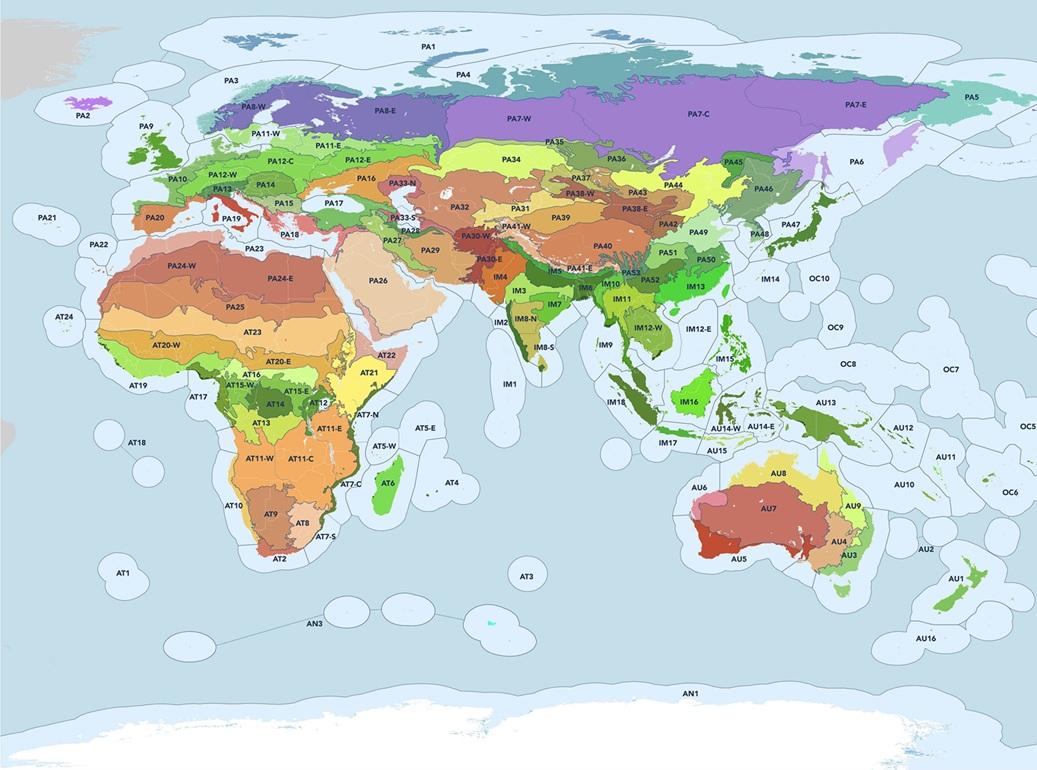
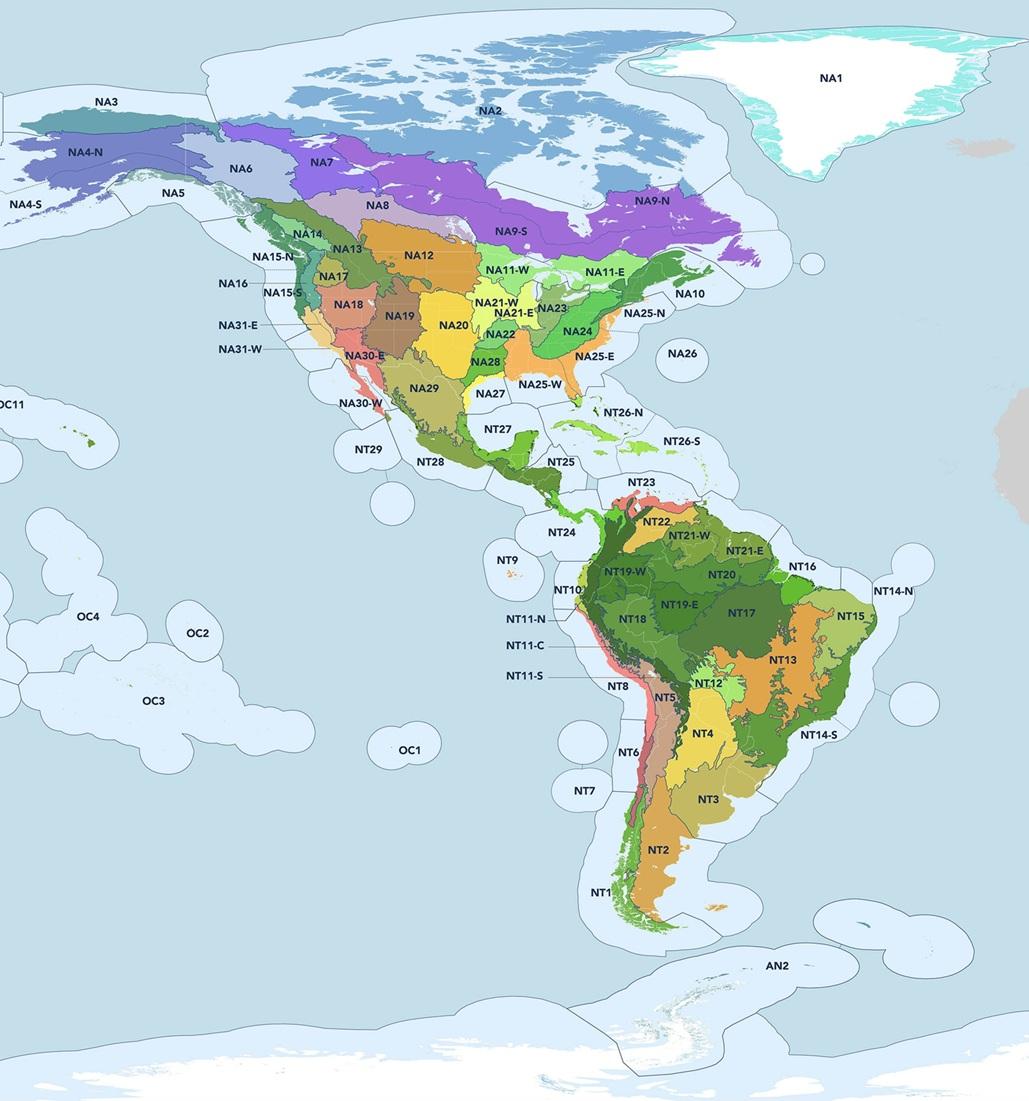
What would the world look like if we mapped it not by political borders but by ecological systems?
Instead of nearly two hundred countries, the planet could be understood as a mosaic of interconnected bioregions, river basins, mountain systems, forests, grasslands, and oceanic zones, each defined by the natural processes that sustain life within them.
This is not merely a thought experiment. Organizations such as One Earth have already begun to conceptualize the world in these terms. Their work identifies a set of global bioregions based on ecological boundaries, offering a framework for understanding how biodiversity, climate, and human activity intersect across the planet.
In such a map, familiar political divisions fade into the background. The Amazon appears not as a set of national territories, but as a single rainforest system. The Himalayas emerge as a continuous mountain ecosystem, shaping water systems across much of Asia. The Indo-Gangetic Plain becomes a unified agricultural and hydrological region, defined by rivers and monsoon patterns rather than borders.
This perspective does not erase nations, but it changes what we notice first.
This perspective does not erase nations, but it changes what we notice first. Instead of asking where one country ends, and another begins, it encourages us to ask how landscapes function, how ecosystems connect, and how human societies interact with the environments they inhabit.
A bioregional map also reveals something else: many of the systems that sustain life on Earth are shared. Rivers flow across borders, atmospheric systems circulate globally, and biodiversity networks extend beyond political jurisdictions. When viewed this way, the divisions that dominate political thinking appear less aligned with the realities of the natural world.
Imagining such a map is not about redrawing borders, but about redrawing perspective. It invites a shift from seeing the world as a collection of separate political units to understanding it as a set of interconnected ecological systems.
And in an age defined by environmental change, the map we choose to see may shape the decisions we choose to make.
Adapted from the One Earth bioregional framework
Identity for the Ecological Age:
The way we define ourselves has always evolved with the structures that shape human life. The rise of the nation-state gave us a language of belonging rooted in borders, sovereignty, and shared political identity. For centuries, that framework has organized how we think about community, responsibility, and governance.
But the challenges of the twenty-first century are increasingly ecological in nature. Climate systems, river basins, forests, and oceans do not operate within national boundaries. They connect societies in ways that political maps often fail to capture.
Bioregionalism does not ask us to abandon national identity. It asks us to expand it—to recognize that we are not only citizens of countries, but also inhabitants of ecosystems. The river basins we depend on, the climates we live within, and the landscapes that sustain us may ultimately shape our future more profoundly than the borders that divide us.
In this sense, the question is not whether nationalism will disappear, but whether it will remain sufficient.
As environmental pressures intensify, the most meaningful map of the world may no longer be the political one we have inherited, but the ecological one we are only beginning to understand.
Charuhas Dali is a research scholar at the Mendel University, Brno, Czech Republic.


